Thailand Faces a G4 Geomagnetic Storm
GISTDA is closely monitoring the solar storm situation as it reaches Earth. Although Thailand is located at a low latitude, it is forecast to be affected by a G4 (Severe Geomagnetic Storm). Satellite users, navigation system operators, and the aviation sector are advised to be aware of possible signal inaccuracies.
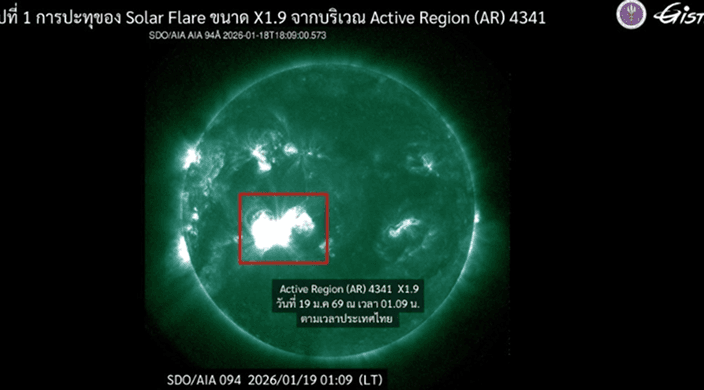
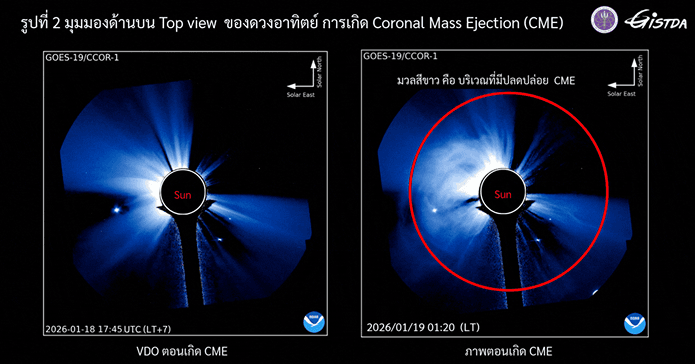
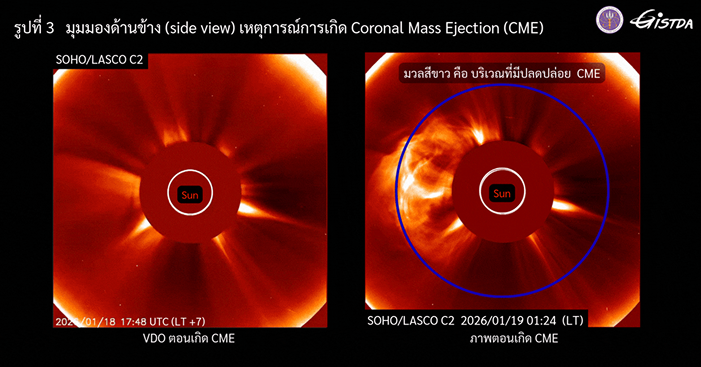
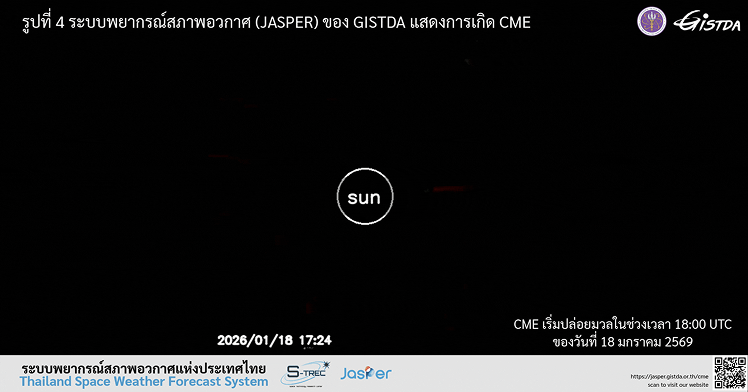
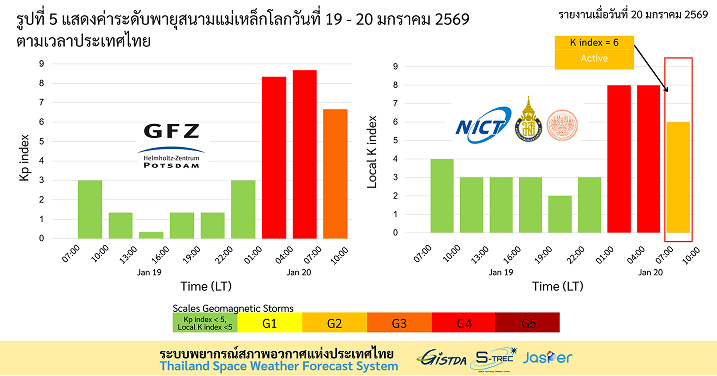
On 19 January 2026 at 01:09 a.m. (Thailand Time), a Solar Flare erupted from Active Region (AR) 4381, as shown in Figure 1. This eruption not only released radiation across various wavelengths but also ejected hot plasma and magnetic fields from the Sun in the form of a Coronal Mass Ejection (CME), which was directed toward Earth. In addition, a coronal hole released solar wind from the Sun, as shown in Figures 2-4, resulting in a severe geomagnetic storm. Based on space weather observations and data from geomagnetic monitoring instruments, Thailand is experiencing a G4 Geomagnetic Storm, as shown in Figure 5.
Three Key Impacts to Watch in Thailand
Although a G4 (Severe Geomagnetic Storm) poses no direct danger to the general public, it may have significant technical impacts on space-based technologies and communication systems, including:
1. Low Earth Orbit (LEO) Satellites May Lose Altitude More Quickly
Increased atmospheric drag can cause Low Earth Orbit (LEO) satellites, such as Earth observation satellites and space stations, to slow down and lose altitude faster than expected. Satellite operators may need to perform orbital adjustment maneuvers to maintain their intended orbits.
2. GPS Navigation May Experience Reduced Accuracy
Global Positioning System (GPS) signals may become less accurate during certain periods, potentially affecting precision navigation applications, including surveying, autonomous drone operations, and precision agriculture.
3. High-Frequency (HF) Aviation Radio Communications May Be Disrupted
High-frequency (HF) radio communication systems used in commercial and military aviation may experience intermittent signal disruptions. Pilots and air traffic controllers should exercise extra caution during affected periods.
Monitoring the Geomagnetic Storm Situation in Thailand
The Space Weather team is continuing to closely monitor the geomagnetic storm situation and will provide updates if there are any significant changes.
The general public does not need to be alarmed, as a geomagnetic storm of this level does not pose a direct risk to human health or household electrical systems in Thailand. However, organizations involved in surveying, long-range radio communications, drone operations, and space-related technologies are advised to closely follow the latest updates. As shown in Figure 5, the geomagnetic storm had weakened to G2 as of 10:00 a.m. (Thailand Time).